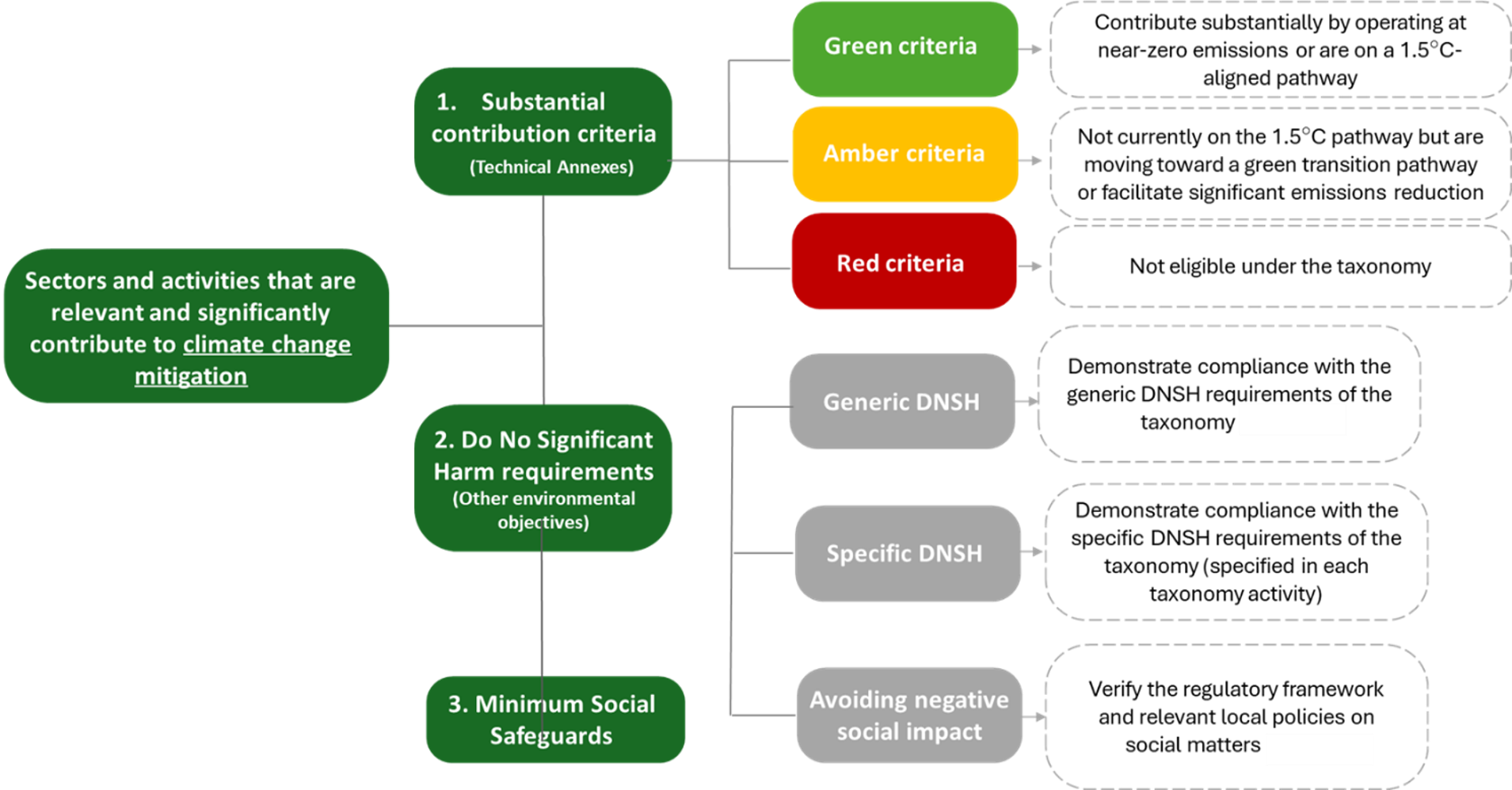
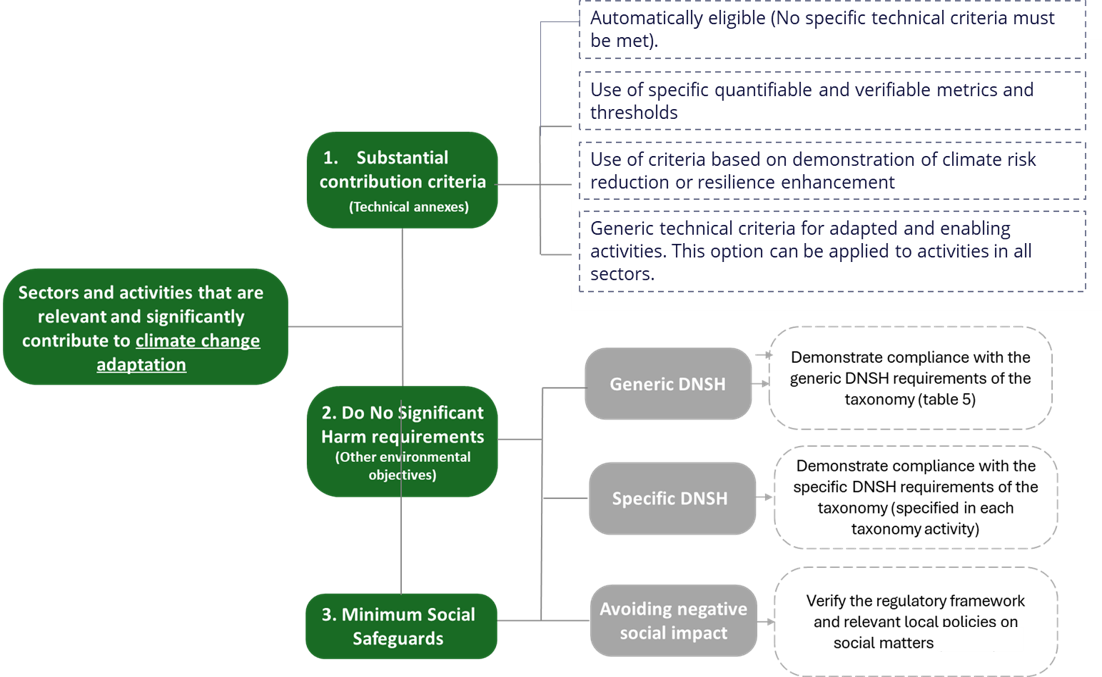
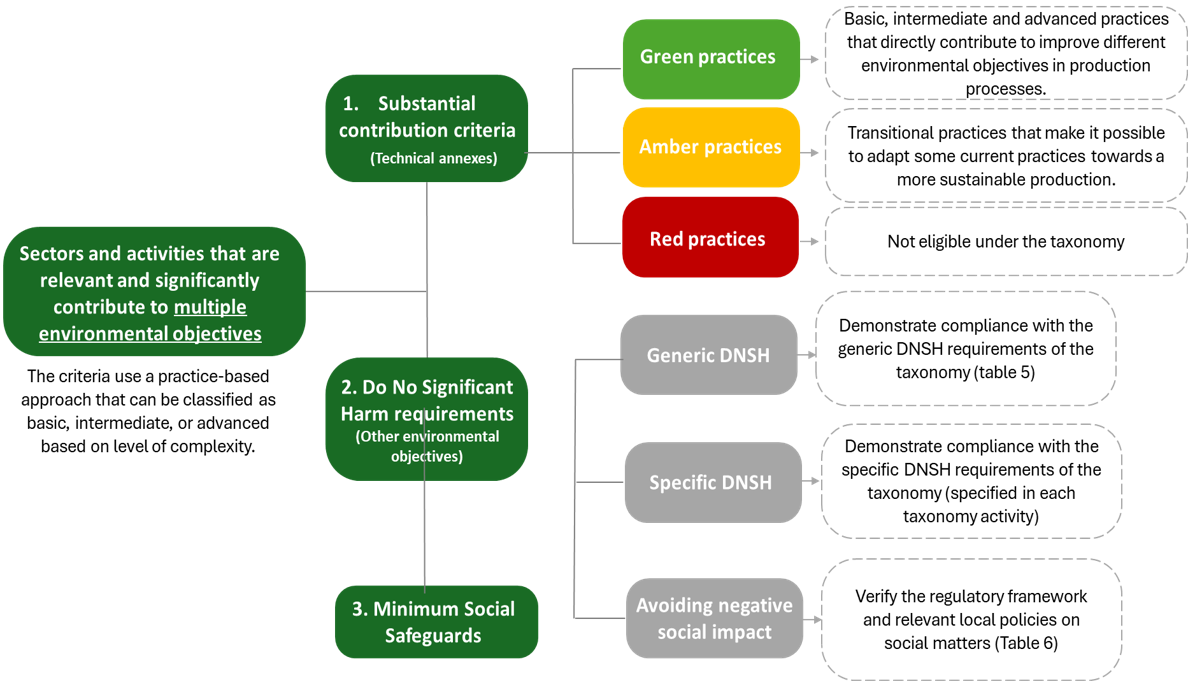
The PGT Navigation tool provides a consolidated query method for identifying relevant sectors and economic activities under Pakistan’s Green Taxonomy. It is designed to help financial institutions and other organizations conduct targeted searches and sequentially retrieve information on Substantial Contribution Criteria and both generic and specific Do No Significant Harm (DNSH) requirements in a summarized and accessible format.
Additionally, the tool supports institutions in identifying, contextualizing, and interpreting economic activities within both national and international frameworks by referencing the corresponding ISIC/PSIC industry codes.
By doing so, the tool enhances the review methodology applied by financial institutions when assessing the compliance of projects with Pakistan’s Green Taxonomy. The steps for using this tool are outlined below:
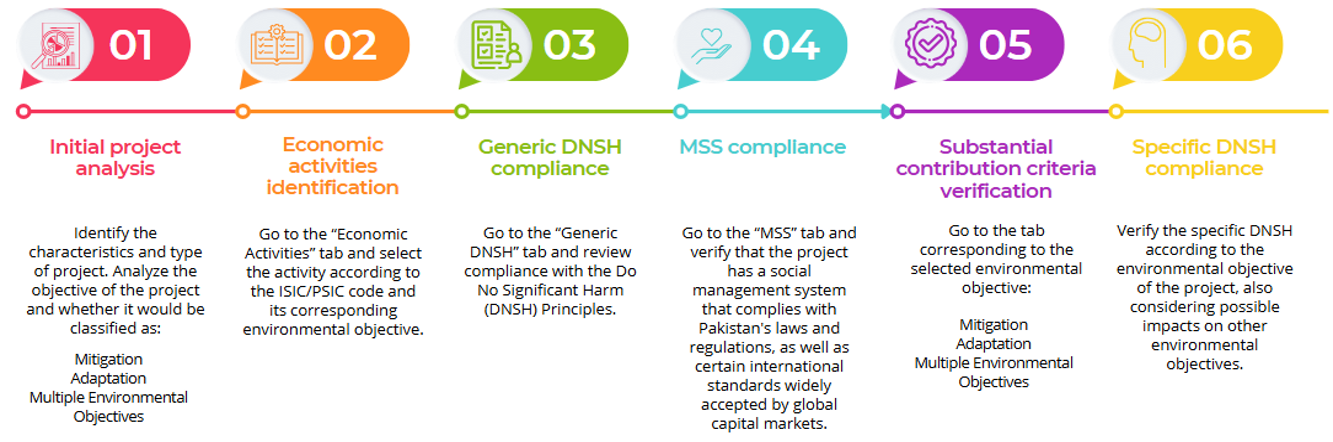
The following steps should be followed when using the PGT Navigation Tool. These steps are designed to guide funders through the project evaluation process, ensuring that the Substantial Contribution Criteria and the relevant DNSH principles (both generic and specific) are applied correctly as defined in the Taxonomy.
Note:
A project is considered eligible when it falls under a sector and economic activity listed in the taxonomy.
A project is considered aligned when, in addition to being eligible, it meets all the technical screening criteria:
Substantial Contribution, Generic DNSH, Specific DNSH, and Minimum Social Safeguards (MSS).
- Initial project analysis: the institution must first undertake an initial assessment of the project proposed by the applicant. Based on this, it must identify whether the project aligns with the objective of climate change mitigation, climate change adaptation, or falls within the scope of multiple environmental objectives.
- Identification of economic activity: the economic activity must be identified and linked to the relevant theme (Mitigation, Adaptation, or Multiple Environmental Objectives). It should then be classified under the appropriate sector. The activity must be mapped to its corresponding ISIC/PSIC code to contextualise the project appropriately.
- Compliance with generic DNSH principles: the institution must verify and document that project is aligned with the generic DNSH principles applicable across all environmental objectives. Compliance with the generic DNSH principles is mandatory for all projects in order to be considered taxonomy-aligned.
- Compliance with Minimum Social Safeguards (MSS): the institution must also verify and demonstrate compliance with the Minimum Social Safeguards, ensuring alignment with national regulations and internationally accepted social standards. All projects must meet MSS requirements as a precondition for taxonomy alignment.
- Verification of Substantial Contribution criteria: the financial institution must assess the Substantial Contribution Criteria applicable to the selected economic activity. It should request the necessary documentation or technical evidence to confirm alignment with these criteria.
- Compliance with specific DNSH principles: the institution must confirm compliance with the specific DNSH criteria related to the project’s potential impacts on other environmental objectives. These criteria define the safeguards and mitigation measures that the applicant and evaluating institution must consider. Where applicable, additional documentation may be required to verify DNSH compliance and prevent adverse impacts on society or the environment. It is essential that the project adheres to the applicable regulatory frameworks and relevant local policies for each economic activity.